...since the media seem to keep confusing terms and their history, although I think it's mostly from ignorance and indolence than for any conspiratorial reason:
"To avoid the confusion that media intentionally creates by mislabeling modern sporting rifles, it’s vital to remember that the firearms sought by [Department of Homeland Security] are banned from civilian commerce by the 1934 National Firearms Act and the Hughes Amendment to the 1986 Firearm Owners Protection Act. Government agencies can buy fully automatic military rifles and call them “suitable for personal defense.” But when a civilian buys the less-functional semi-automatic variant, it becomes an “assault weapon.'"
And this: "Following December’s massacre at Sandy Hook Elementary School, we have witnessed the spectacle of politicians at every level of government tripping over each other to race before the cameras and proclaim their outrage, not at the perpetrator of the atrocity, but rather at the many law-abiding Americans who are employed in the making of firearms and the many, many more who use them recreationally. Something must be done, they tell us, “for the children.” That the “something” might be wholly ineffectual or even counterproductive in the fight against crime is of little significance when the real goal is to see one’s name in the headlines and one’s face on television."
The use of children as props for political press conferences is reprehensible; even more so when politicians exploit the grief of the victims' parents for their own dark purposes. In every mass shooting in the last fifteen years, psychotropic medication has been used, sometimes long-term, by the shooter. Why aren't we talking about that, too? It's enough to make me think that, on the national stage, this is just an attempt to distract the press and public from the economy and, at state level, because Pfizer is a major employer in our area [and contributor to the current governor's campaign treasure chest].
You can always count on a bureaucracy to think clearly and offer good, sound advice.
NY Post: Is your workplace getting shot up by a crazed gunman? No problem — just grab a pair of scissors and fight back! That’s some of the helpful advice in a new instructional video from the Department of Homeland Security that was posted on the agency’s Web site just a month after the massacre at Sandy Hook Elementary School in Connecticut
Thursday, January 31, 2013
Some Good News On The Historical Front
Intrepid Citizens Save Timbuktu’s Priceless Manuscripts:
Once again civilization survives barbarism: Timbuktu’s ancient literary treasures were not destroyed after all. In a classic example of how the uncertainty of war can make bad reporters of us all, local accounts apparently vastly exaggerated the damage done to the city’s legendary library. Not only was the place not burned to the ground—as the city’s mayor claimed—but the manuscripts themselves were removed from the library by Malians last year.It's an ugly thing when a religion designed to promote serenity is taken over by a collection of over-excited, intellectually incestuous barbarians. I hope that true Islam will prevail during my lifetime, but I wonder how lasting is to be the rise of those panicked that the world cannot and will not return to the 600's. The fact that both Australia and the United States are on the verge of overtaking Arab oil resources and production will make things all the more volatile.
Thursday's Verses
Come sing, ye choirs exultant,
those messengers of God,
through whom the living Gospels
came sounding all abroad!
Whose voice proclaimed salvation
that poured upon the night,
and drove away the shadows,
and flushed the world with light.
those messengers of God,
through whom the living Gospels
came sounding all abroad!
Whose voice proclaimed salvation
that poured upon the night,
and drove away the shadows,
and flushed the world with light.
Wednesday, January 30, 2013
Tales From The Secular World
Shaming fat people into losing weight is the only way to solve obesity epidemic, leading health academic claims
Public shaming makes a comeback. This fellow should test his theory on Chris Christie or Hillary Clinton and see how well it works. I'm sure it would be warmly received.
Public shaming makes a comeback. This fellow should test his theory on Chris Christie or Hillary Clinton and see how well it works. I'm sure it would be warmly received.
The Intellectual Marketplace That Is The Contemporary University
"Only hours after students installed a “Free Speech Wall” at Carleton University to prove that campus free speech was alive and well, it was torn down by an activist who claimed the wall was an “act of violence.”
This is a fun quotation: "In a Tuesday afternoon Twitter exchange with a CBC reporter, Mr. Smith dubbed free speech an 'illusory concept' and declared that 'not every opinion is valid, nor deserving of expression.'”
Mr. Smith, I might add, is a seventh-year student at the four-year college.
This is a fun quotation: "In a Tuesday afternoon Twitter exchange with a CBC reporter, Mr. Smith dubbed free speech an 'illusory concept' and declared that 'not every opinion is valid, nor deserving of expression.'”
Mr. Smith, I might add, is a seventh-year student at the four-year college.
Why Are These People Allowed To Have Guns?
Bystander shot by police to sue city
When our parish administrator can out-shoot the police, the NYPD may need to adjust their training.
When our parish administrator can out-shoot the police, the NYPD may need to adjust their training.
Somehow This Will Linger For Me As A Sign Of These Times
"Beyoncé’s dazzling rendition of the National Anthem at President Obama’s inauguration was a total fake — with the megastar lip-syncing as the Marine Corps Band merely pretended to play its instruments...."
Celebrities who earn fame without talent, the media-forced worship of millionaires that infects even the network news broadcasts, appearance as more important than reality; there is only one time that Western history has seen such a collision of social attitudes, and that was Rome in the 4th century.
Celebrities who earn fame without talent, the media-forced worship of millionaires that infects even the network news broadcasts, appearance as more important than reality; there is only one time that Western history has seen such a collision of social attitudes, and that was Rome in the 4th century.
Tuesday, January 29, 2013
Tuesday's Quotation
“It is not what you are nor what you have been that God sees with
all-merciful eyes, but what you desire to be.” – from The Cloud of Unknowing
Monday, January 28, 2013
This Week's Lesser Feasts
January 28: Thomas Aquinas [1225–1274]

It seems hard to believe now, but there was a time, specifically in the 13th century, when the works of Aristotle had fallen out of common usage and were unstudied in the universities of Europe. Thanks to the Muslim scholars of Arabia and Spain, who were enamored of Aristotle's natural philosophy [Islam and its relationship with Western thought has really changed since then, eh?], Aristotle was ready for re-discovery when Thomas of Acquin, a Dominican monk of no small intellect, published a series of works re-presenting Aristotelian thought to his contemporaries and matching it with the theological framework of medieval Christianity. [It is helpful to remember, despite what trendy secularists would have one believe, that Christianity created the university model that educates the Western world to this day; not to mention also enabling scientific method to develop.]
As one with degrees in both philosophy and theology, I can testify to the continued influence of Aquinas in both fields. In fact, his popularity in secular philosophy continues to grow. All subsequent Western philosophy is in reaction to Aquinas's works. There is no greater figure in history whose accomplishments so strongly stand in the face of the errant belief that there is, or should be, a separation between theology, philosophy, and science.
Perhaps his most interesting contribution to human thought is through the field of natural theology. In an overly succinct definition, natural theology is the study of God as known not through sudden revelation, but through the application of observation and reason.
I would encourage readers to follow the links for more information. I will leave with this piquant quotation from G.K. Chesterton, the Catholic writer [and creator of the literary detective "Fr. Brown"] as to Aquinas's ecclesial abilities and ambition:
"His experiences included well-attested cases of levitation in ecstasy; and the Blessed Virgin appeared to him, comforting him with the welcome news that he would never be a Bishop."
Almighty God, you have enriched your Church with the singular learning and holiness of your servant Thomas Aquinas: Enlighten us more and more, we pray, by the disciplined thinking and teaching of Christian scholars, and deepen our devotion by the example of saintly lives; through Jesus Christ our Lord, who lives and reigns with you and the Holy Spirit, one God, for ever and ever. Amen.
February 1: Brigid of Kildare [450-525]

Bridget (aka Brigid, Bride, or Bridey) of Kildare was born around 450 into a Druid family, and was the daughter of Dubhthach, the official poet to the king, a position of considerable social importance and political influence. At an early age, inspired by the sermons of St. Padraic [or Patrick], she decided to become a Christian and eventually took vows as a nun. With a group of like-minded women, she established a convent at Kildare. Bridget was later joined by a community of monks, as pre-Roman Celtic Christian evangelism [there's that word, again] was based on coeducational monastic houses. [Celtic monks and nuns did not include chastity as one of their holy vows and, as such, were permitted to live together in community, marry, and procreate. Roman Christianity, which would become the standard in the British Isles a century of so after the death of Bridget, would forbid such normal and sacramental relations between ascetic men and women.]
Kildare was a pagan shrine where a sacred fire was perpetually burning, and Bridget and her nuns, instead of extinguishing the fire, maintained it with a Christian interpretation. This was the evangelical practice of the era as Druidism gave way to Christianity with rare opposition, as the Druids understood their own beliefs were of a transient nature, recognizing in Christianity a completion of their beliefs.
As an abbess, Bridget participated in several Irish councils, and her influence on the policies of the Church in Ireland was immeasurable. She is thought to have died in the year 525. On the Irish calendar, this is the first day of spring, thus this date was assigned as her feast since her name, in both the druidic and Christian traditions, represents new beginnings.
Above is a cross made of rushes, called a "Bridget's cross", as she once wove such a devotional for a dying man.

Everliving God, we rejoice today in the fellowship of your blessed servant Brigid, and give you thanks for her life of devoted service. Inspire us with life and light, and give us perseverance to serve you all our days; through Jesus Christ our Lord, who with you and the Holy Spirit lives and reigns, one God, for ever and ever. Amen.

It seems hard to believe now, but there was a time, specifically in the 13th century, when the works of Aristotle had fallen out of common usage and were unstudied in the universities of Europe. Thanks to the Muslim scholars of Arabia and Spain, who were enamored of Aristotle's natural philosophy [Islam and its relationship with Western thought has really changed since then, eh?], Aristotle was ready for re-discovery when Thomas of Acquin, a Dominican monk of no small intellect, published a series of works re-presenting Aristotelian thought to his contemporaries and matching it with the theological framework of medieval Christianity. [It is helpful to remember, despite what trendy secularists would have one believe, that Christianity created the university model that educates the Western world to this day; not to mention also enabling scientific method to develop.]
As one with degrees in both philosophy and theology, I can testify to the continued influence of Aquinas in both fields. In fact, his popularity in secular philosophy continues to grow. All subsequent Western philosophy is in reaction to Aquinas's works. There is no greater figure in history whose accomplishments so strongly stand in the face of the errant belief that there is, or should be, a separation between theology, philosophy, and science.
Perhaps his most interesting contribution to human thought is through the field of natural theology. In an overly succinct definition, natural theology is the study of God as known not through sudden revelation, but through the application of observation and reason.
I would encourage readers to follow the links for more information. I will leave with this piquant quotation from G.K. Chesterton, the Catholic writer [and creator of the literary detective "Fr. Brown"] as to Aquinas's ecclesial abilities and ambition:
"His experiences included well-attested cases of levitation in ecstasy; and the Blessed Virgin appeared to him, comforting him with the welcome news that he would never be a Bishop."
Almighty God, you have enriched your Church with the singular learning and holiness of your servant Thomas Aquinas: Enlighten us more and more, we pray, by the disciplined thinking and teaching of Christian scholars, and deepen our devotion by the example of saintly lives; through Jesus Christ our Lord, who lives and reigns with you and the Holy Spirit, one God, for ever and ever. Amen.
February 1: Brigid of Kildare [450-525]

Bridget (aka Brigid, Bride, or Bridey) of Kildare was born around 450 into a Druid family, and was the daughter of Dubhthach, the official poet to the king, a position of considerable social importance and political influence. At an early age, inspired by the sermons of St. Padraic [or Patrick], she decided to become a Christian and eventually took vows as a nun. With a group of like-minded women, she established a convent at Kildare. Bridget was later joined by a community of monks, as pre-Roman Celtic Christian evangelism [there's that word, again] was based on coeducational monastic houses. [Celtic monks and nuns did not include chastity as one of their holy vows and, as such, were permitted to live together in community, marry, and procreate. Roman Christianity, which would become the standard in the British Isles a century of so after the death of Bridget, would forbid such normal and sacramental relations between ascetic men and women.]
Kildare was a pagan shrine where a sacred fire was perpetually burning, and Bridget and her nuns, instead of extinguishing the fire, maintained it with a Christian interpretation. This was the evangelical practice of the era as Druidism gave way to Christianity with rare opposition, as the Druids understood their own beliefs were of a transient nature, recognizing in Christianity a completion of their beliefs.
As an abbess, Bridget participated in several Irish councils, and her influence on the policies of the Church in Ireland was immeasurable. She is thought to have died in the year 525. On the Irish calendar, this is the first day of spring, thus this date was assigned as her feast since her name, in both the druidic and Christian traditions, represents new beginnings.
Above is a cross made of rushes, called a "Bridget's cross", as she once wove such a devotional for a dying man.

Everliving God, we rejoice today in the fellowship of your blessed servant Brigid, and give you thanks for her life of devoted service. Inspire us with life and light, and give us perseverance to serve you all our days; through Jesus Christ our Lord, who with you and the Holy Spirit lives and reigns, one God, for ever and ever. Amen.
Sunday, January 27, 2013
Friday, January 25, 2013
Waldo Peirce
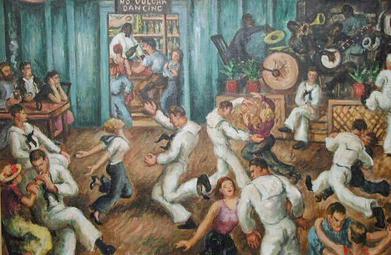
"I'm a painter, not an artist".
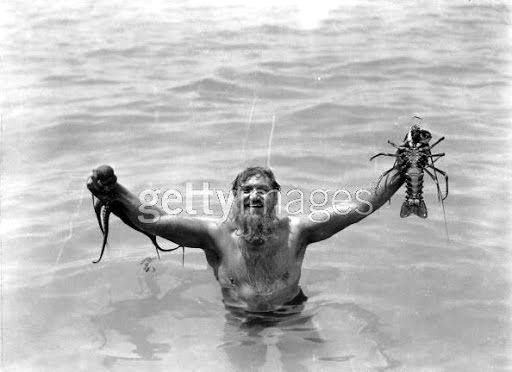
I always wanted to write a biography of Waldo Peirce, mainly because of two photographs, separated by about twenty years. The first is of Peirce with his Harvard roommate; the second of Peirce with a writer friend on a beach in France in the 1920's. There is nothing remarkable about either photograph, except that his college roommate would become one of the most influential and famous journalists of the early 20th century and his beach buddy would win the Nobel Prize for Literature.
There is much about Peirce that I really shouldn't care for, as he was born into money, had a first-class education shoved into his grudging hands, and was able to move easily through the seminal experiences of the American century, dragging along four wives, five children, and a considerable number of paintings. It all came to him rather easily, along with rude health and vigor. He once stated that he never worked a day in his life.
But, what's interesting about him is that he was what Goethe and Balzac referred to in their respective languages as a "life-artist". As we have seen before with literary artists such as Yukio Mishima and James Magner, there is something compelling about those who wish not only to create tactile art, but to merge their lives with it so that it is a seamless expression of the sheer joy of living out of the bounds of normal expectation.
Peirce was sent to Phillips Andover and then to Harvard where his roommate was John Reed, eventual author of Ten Days That Shook The World, who was a great chronicler of the worker's movement in the United States and of the Russian Revolution. So prized was Reed's sympathetic reporting during Lenin's rise to power that he is buried in the Kremlin Wall. [Some may recall a film of thirty years back entitled "Reds", which starred Warren Beatty as Reed]. Reed and Peirce took a trip to Europe upon graduation and got into some trouble with the shipping line on the return voyage. Peirce, upon leaving port, decided that the ship and its accommodations weren't to his liking so he jumped overboard and swam back to shore. Upon discovering a missing passenger, the ship's captain had Reed locked in the brig under suspicion of murder. There are a number of endings to this story, the most amusing is that Peirce was waiting at the dock upon Reed's arrival back in the United States, having taken a faster ship, thus untangling the potential murder charges.
During World War I, like other men who would one day claim distinction in the art world [a full list may be found here], Peirce joined the Red Cross Ambulance Corps and served with distinction at the front, gaining some French medals along the way. After the war, and again like many Americans who served, he remained in Paris to be a part of the very large and creative expatriate community that included Ernest Hemingway, who became one of Peirce's life-long friends.
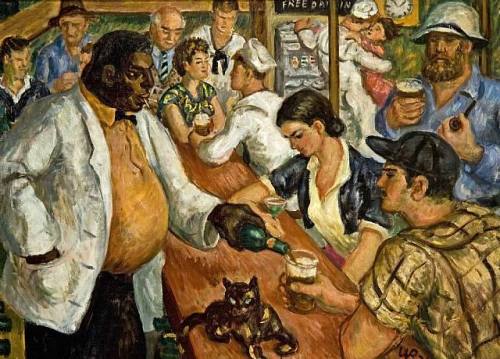
From a Harvard Magazine article from some years back:
Living and painting in Paris off and on in the 1920s, Peirce became friends with many of the notables who defined this period in the arts: Gertrude Stein, James Joyce, Sylvia Beach, Bernice Abbott, Archibald MacLeish, LL.B. ’19, John Dos Passos ’16—and Ernest Hemingway, another wartime ambulance driver. He and Hemingway stayed friends for life, a relationship not sustained by many other Hemingway associates from the Paris days; their letters to each other were filled with news, gossip, and witty passages, often interlaced with Spanish and French asides. Both men were voracious readers. Both were remarkable presences in a room, regaling others with ribald tales, great stories, and vivid word pictures. Their six-foot frames and beards were as impressive as their artistic talents. (Peirce was occasionally referred to as the “Hemingway of American painting,” but said once that made as much sense as “calling Hemingway ‘the Peirce of American literature.’”) Both men shared a formidable gusto for life and adventure—each married four times—and possessed an unending, consuming curiosity about the world around them. Fishing was their passion, and several times Peirce joined Hemingway in the Dry Tortugas and the Marquesas Keys. Never without a sketchbook, he captured these expeditions in oils and watercolors. When Hemingway’s face graced the cover of Time in 1937—he had just published To Have and Have Not—the magazine used a Peirce portrait of his friend holding a fishing pole, eyes focused on the line. The two can also be found together in other Peirce paintings—fighting bulls in Pamplona, drinking in Sloppy Joe’s in Key West, catching tarpon in the Gulf Stream.On his many visits to Key West, Peirce was always sure to bring both his paints and his children, along with a rather singular sense of the duties of fatherhood. Hemingway wrote in a letter:
"Waldo is here with his kids like untrained hyenas and him as domesticated as a cow. Lives only for the children and with the time he puts on them they should have good manners and be well trained but instead they never obey, destroy everything, don't even answer when spoken to, and he is like an old hen with a litter of apehyenas. I doubt if he will go out in the boat while he is here. Can't leave the children. They have a nurse and a housekeeper too, but he is only really happy when trying to paint with one setting fire to his beard and the other rubbing mashed potato into his canvasses. That represents fatherhood."
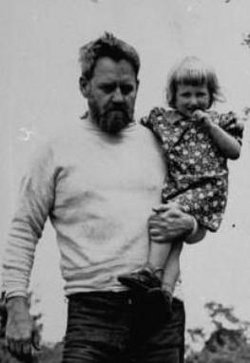
He lived a long life and left many works of art scattered about museums both great and small, including the Smithsonian. The bulk of his estate was left to Colby College in Maine, near where he lived his final two decades, including not only paintings but some of the most entertaining letters one can ever hope to read.
Thursday, January 24, 2013
Thursday's Verses
Sun and moon shall darkened be,
stars shall fall, the heavens shall flee;
Christ will then like lightning shine,
all will see his glorious sign;
all will then the trumpet hear,
all will see the Judge appear;
thou by all wilt be confessed,
God in man made manifest.
stars shall fall, the heavens shall flee;
Christ will then like lightning shine,
all will see his glorious sign;
all will then the trumpet hear,
all will see the Judge appear;
thou by all wilt be confessed,
God in man made manifest.
Wednesday, January 23, 2013
Newsflash: Episcopal Clergyman Says Something Liberal

Episcopal dean of the National Cathedral teaming up with Democrats on guns
Judging from the dean's "invocation" at the gun control presentation at the Senate, one cannot be a true Christian or, particularly, an Episcopalian if one belongs to the "gun lobby" or owns a rifle. Hypothetically, what does that make an Episcopal priest who owns a rifle and belongs to the NRA? I'm given the understanding by his comments that the dean does not think such creatures exist. Is that priest no longer be a member of the ordained "club"? Would he/she be judged as somehow disharmonious and worthy of shunning or shaming? Groupthink is alive and well in both academy and church, apparently.
Begone, Peasants. Only The Wealthy May Be Protected.
The mayor also takes along a police detail when he travels, flying two officers on his private plane and paying as much as $400 a night to put them up at a hotel near his house; the city pays their wages while they are there, as it does whether Mr. Bloomberg is New York or not. Guns are largely forbidden in Bermuda — even most police officers do not use them — but the mayor’s guards have special permission to carry weapons. A spokesman for the Police Department declined to comment.
I'll bet. This from the guy who doesn't want the peons to legally own guns.
By the way, some politician should regulate the mayor's intake of red meat. He's eating too much of it.
I'll bet. This from the guy who doesn't want the peons to legally own guns.
By the way, some politician should regulate the mayor's intake of red meat. He's eating too much of it.
I Think I Have A Strategy Should I Ever Wish To Rob A Denny's
Police Kicked Out Of Belleville Denny’s For Being Armed
They made a customer "uncomfortable", you see.
They made a customer "uncomfortable", you see.
Oh, Bishops! Here's A Cause In Need Of Address
Rampant sexism in regards to both access to power and access to wealth:
The White House’s Flickr account recently released a photo of President Barack Obama and his top advisers. The complete absence of women in the image is another reminder that females are underrepresented in Obama’s staff.
Additionally, the president still pays his female employees significantly less than their male counterparts.
More from the Washington Post: Obama’s failure to nominate women for two top Cabinet posts questioned
If a bishop tried to have an all-male staff, there would be considerable commotion. Heck, the bishops would never let a Republican president get away with this. Are we merely pawns of one secular political party or are we to stand for a greater cause of social justice? I've been told my entire career in the Episcopal Church that we speak truth to power. What suddenly happened? Do we speak truth only to certain forms of power? Do we respect the dignity of every human being, as long as that person agrees with our ideology with unquestioning totality?
The White House’s Flickr account recently released a photo of President Barack Obama and his top advisers. The complete absence of women in the image is another reminder that females are underrepresented in Obama’s staff.
Additionally, the president still pays his female employees significantly less than their male counterparts.
More from the Washington Post: Obama’s failure to nominate women for two top Cabinet posts questioned
If a bishop tried to have an all-male staff, there would be considerable commotion. Heck, the bishops would never let a Republican president get away with this. Are we merely pawns of one secular political party or are we to stand for a greater cause of social justice? I've been told my entire career in the Episcopal Church that we speak truth to power. What suddenly happened? Do we speak truth only to certain forms of power? Do we respect the dignity of every human being, as long as that person agrees with our ideology with unquestioning totality?
Tuesday, January 22, 2013
Tuesday's Quotation
"God has created me with free will. If I have sinned, I have sinned…. I, not fate, not chance, not the devil." —St. Augustine
Monday, January 21, 2013
This Week's Lesser Feasts
January 21: Agnes of Rome [292-304]

A popular saint about whom little is known, Agnes is said to have been a beautiful, wealthy Roman maiden who had, in childhood, dedicated herself to God. Some say that a rejected suitor betrayed her to authorities; others say that she was asked at 13 to sacrifice to the gods and marry, both of which she refused. Legends tell of her being thrown into a brothel, where her purity was miraculously preserved. Having escaped that fate, she was martyred. In the IV Century, Constantia, the daughter of Constantine, built a basilica on the site of her tomb....Her emblem in art is the lamb because of the similarity between her name and the Latin word for lamb, agnus.
Almighty and everlasting God, you choose those whom the world deems powerless to put the powerful to shame: Grant us so to cherish the memory of your youthful martyr Agnes, that we may share her pure and steadfast faith in you; through Jesus Christ our Lord, who lives and reigns with you and the Holy Spirit, one God, for ever and ever. Amen.
January 22: Vincent of Saragossa, Deacon and Martyr [? - 304]

Deacon and martyr. Born at Huesca, Spain, he became a deacon and served St, Valerius at Saragossa until his martyrdom at Valencia during the persecutions under Emperor Diocletian (r. 284-305). St. Valerius was exiled, but Vincent was cruelly tortured because he would not surrender the holy books. He converted the warden of the prison and then died. He was honored by Sts. Augustine, Pope Leo I, and Prudentius, and is considered the patron saint of vinedressers in some regions of Spain.
Almighty God, your deacon Vincent, upheld by you, was not terrified by threats nor overcome by torments: Strengthen us to endure all adversity with invincible and steadfast faith; through Jesus Christ our Lord, who lives and reigns with you and the Holy Spirit, one God, for ever and ever. Amen.
January 23: Philips Brooks, Bishop of Massachusetts [1835-1893]

A member of a wealthy old Brahmin family of New England, Brooks attended Harvard University (1851–55) and taught briefly at the Boston Latin School before attending the Episcopal Seminary at Alexandria, Va., being ordained there on July 1, 1859. The following month he began his ministry at the Church of the Advent in Philadelphia, where his impressive personality and eloquence won crowds of admirers. Three years later he became rector of Holy Trinity in the same city. Except for a year of travel abroad in 1865–66, he remained there seven years, during which he finished the lyrics of his famous Christmas carol, “O Little Town of Bethlehem” (music by Lewis H. Redner). In 1869 he accepted the rectorship of Boston’s Trinity Church, the nation’s stronghold of Episcopalianism, and retained that position until he became bishop of Massachusetts in 1891.
In Lectures on Preaching (delivered at Yale University in 1877), Brooks offered his most influential assay of his profession, defining preaching as “the bringing of truth through personality,” by which he meant a kind of radiant optimism. His own eloquence was matched by his commanding, handsome figure, standing six feet four inches tall and weighing (in his prime) 300 pounds. His charismatic preaching became so renowned that he was invited in 1880 to preach at Westminster Abbey in London and at the Royal Chapel at Windsor before Queen Victoria. In 1890 he conducted an acclaimed series of services at Trinity Church, New York City. Several volumes of his sermons were published during his lifetime and posthumously.
I would add to the "canned" commentary above that there was considerable competition for the title "greatest preacher of the 19th century", as it was a more pious and unapologetically Christian age, yet Brooks was undeniably such. As his composition formed the content of our Christmas Eve sermon this past month, we know of the genesis of that simple hymn, "O Little Town of Bethlehem", and how it brought a sense of healing to Brooks and to his parishioners upon the close of the Civil War and the assassination of Abraham Lincoln. If you weren't in church to hear it, you're out of luck.
O everlasting God, you revealed truth to your servant Phillips Brooks, and so formed and molded his mind and heart that he was able to mediate that truth with grace and power: Grant, we pray, that all whom you call to preach the Gospel may steep themselves in your Word, and conform their lives to your will; through Jesus Christ our Lord, who lives and reigns with you and the Holy Spirit, one God, for ever and ever. Amen.
January 24: Florence Li Tim-Oi [1907-1992]

Li Tim-Oi was born in Hong Kong in 1907. When she was baptized as a student, she chose the name of Florence in honor of Florence Nightingale. Florence studied at Union Theological College in Guangzhou (Canton). In 1938, upon graduation, she served in a lay capacity, first in Kowloon and then in nearby Macao.
In May 1941 Florence was ordained deaconess. Some months later Hong Kong fell to Japanese invaders, and priests could not travel to Macao to celebrate the Eucharist. Despite this setback, Florence continued her ministry. Her work came to the attention of Bishop Ronald Hall of Hong Kong, who decided that “God’s work would reap better results if she had the proper title” of priest.
On January 25, 1944, the Feast of the Conversion of St. Paul, Bishop Hall ordained her priest, the first woman so ordained in the Anglican Communion.
When World War II came to an end, Florence Li Tim-Oi’s ordination was the subject of much controversy. She made the personal decision not to exercise her priesthood until it was acknowledged by the wider Anglican Communion. Undeterred, she continued to minister with great faithfulness, and in 1947 was appointed rector of St. Barnabas Church in Hepu where,on Bishop Hall’s instructions, she was still to be called priest.
When the Communists came to power in China in 1949, Florence undertook theological studies in Beijing to further understand the implications of the Three-Self Movement (self-rule, self-support, and self- propagation) which now determined the life of the churches. She then moved to Guangzhou to teach and to serve at the Cathedral of Our Savior. However, for sixteen years, from 1958 onwards, during the Cultural Revolution, all churches were closed. Florence was forced to work first on a farm and then in a factory. Accused of counter revolutionary activity, she was required to undergo political re-education. Finally, in 1974, she was allowed to retire from her work in the factory.
In 1979 the churches reopened, and Florence resumed her public ministry. Then, two years later, she was allowed to visit family members living in Canada. While there, to her great joy, she was licensed as a priest in the Diocese of Montreal and later in the Diocese of Toronto,where she finally settled, until her death on February 26, 1992.
Allow me to offer some controversial observations, as I was active in the church upon the initial "discovery" of Li Tim-Oi's story. Mother Li was so unknown that, upon the much-trumpeted occasion of the ordination of the first women clergy in 1974, we were not generally aware that the Anglican Communion had already ordained a woman to the priesthood more than thirty years before. Once Mother Li's remarkable story was discovered, it deflated some of the self-importance of the newly ordained, all of whom were white and economically privileged; two things Mother Li was not. The fact that Mother Li was nothing if not humble, even by Chinese standards, didn't make her story any more than grudgingly popular in the American church, as the ecclesial style of the day was stridently "ME"- oriented. It seemed that it was only out of good Episcopal manners that she was initially granted a date on the calendar.
Anyone who met her in person, as I was so honored when we shared a lecture hall at the University of Toronto, would have recognized being in the presence of a true priest. She lived to serve God, not self, and reached beyond culture to preach a quiet, simple message of faith. I'm glad she was the first woman priest, as she set a standard that is inspiring, catholic and universal.
Gracious God, we thank you for calling Florence Li Tim-Oi, much beloved daughter, to be the first woman to exercise the office of a priest in our Communion: By the grace of your Spirit inspire us to follow her example, serving your people with patience and happiness all our days, and witnessing in every circumstance to our Savior Jesus Christ, who lives and reigns with you and the same Spirit, one God, for ever and ever. Amen.
A popular saint about whom little is known, Agnes is said to have been a beautiful, wealthy Roman maiden who had, in childhood, dedicated herself to God. Some say that a rejected suitor betrayed her to authorities; others say that she was asked at 13 to sacrifice to the gods and marry, both of which she refused. Legends tell of her being thrown into a brothel, where her purity was miraculously preserved. Having escaped that fate, she was martyred. In the IV Century, Constantia, the daughter of Constantine, built a basilica on the site of her tomb....Her emblem in art is the lamb because of the similarity between her name and the Latin word for lamb, agnus.
Almighty and everlasting God, you choose those whom the world deems powerless to put the powerful to shame: Grant us so to cherish the memory of your youthful martyr Agnes, that we may share her pure and steadfast faith in you; through Jesus Christ our Lord, who lives and reigns with you and the Holy Spirit, one God, for ever and ever. Amen.
January 22: Vincent of Saragossa, Deacon and Martyr [? - 304]
Deacon and martyr. Born at Huesca, Spain, he became a deacon and served St, Valerius at Saragossa until his martyrdom at Valencia during the persecutions under Emperor Diocletian (r. 284-305). St. Valerius was exiled, but Vincent was cruelly tortured because he would not surrender the holy books. He converted the warden of the prison and then died. He was honored by Sts. Augustine, Pope Leo I, and Prudentius, and is considered the patron saint of vinedressers in some regions of Spain.
Almighty God, your deacon Vincent, upheld by you, was not terrified by threats nor overcome by torments: Strengthen us to endure all adversity with invincible and steadfast faith; through Jesus Christ our Lord, who lives and reigns with you and the Holy Spirit, one God, for ever and ever. Amen.
January 23: Philips Brooks, Bishop of Massachusetts [1835-1893]
A member of a wealthy old Brahmin family of New England, Brooks attended Harvard University (1851–55) and taught briefly at the Boston Latin School before attending the Episcopal Seminary at Alexandria, Va., being ordained there on July 1, 1859. The following month he began his ministry at the Church of the Advent in Philadelphia, where his impressive personality and eloquence won crowds of admirers. Three years later he became rector of Holy Trinity in the same city. Except for a year of travel abroad in 1865–66, he remained there seven years, during which he finished the lyrics of his famous Christmas carol, “O Little Town of Bethlehem” (music by Lewis H. Redner). In 1869 he accepted the rectorship of Boston’s Trinity Church, the nation’s stronghold of Episcopalianism, and retained that position until he became bishop of Massachusetts in 1891.
In Lectures on Preaching (delivered at Yale University in 1877), Brooks offered his most influential assay of his profession, defining preaching as “the bringing of truth through personality,” by which he meant a kind of radiant optimism. His own eloquence was matched by his commanding, handsome figure, standing six feet four inches tall and weighing (in his prime) 300 pounds. His charismatic preaching became so renowned that he was invited in 1880 to preach at Westminster Abbey in London and at the Royal Chapel at Windsor before Queen Victoria. In 1890 he conducted an acclaimed series of services at Trinity Church, New York City. Several volumes of his sermons were published during his lifetime and posthumously.
I would add to the "canned" commentary above that there was considerable competition for the title "greatest preacher of the 19th century", as it was a more pious and unapologetically Christian age, yet Brooks was undeniably such. As his composition formed the content of our Christmas Eve sermon this past month, we know of the genesis of that simple hymn, "O Little Town of Bethlehem", and how it brought a sense of healing to Brooks and to his parishioners upon the close of the Civil War and the assassination of Abraham Lincoln. If you weren't in church to hear it, you're out of luck.
O everlasting God, you revealed truth to your servant Phillips Brooks, and so formed and molded his mind and heart that he was able to mediate that truth with grace and power: Grant, we pray, that all whom you call to preach the Gospel may steep themselves in your Word, and conform their lives to your will; through Jesus Christ our Lord, who lives and reigns with you and the Holy Spirit, one God, for ever and ever. Amen.
January 24: Florence Li Tim-Oi [1907-1992]
Li Tim-Oi was born in Hong Kong in 1907. When she was baptized as a student, she chose the name of Florence in honor of Florence Nightingale. Florence studied at Union Theological College in Guangzhou (Canton). In 1938, upon graduation, she served in a lay capacity, first in Kowloon and then in nearby Macao.
In May 1941 Florence was ordained deaconess. Some months later Hong Kong fell to Japanese invaders, and priests could not travel to Macao to celebrate the Eucharist. Despite this setback, Florence continued her ministry. Her work came to the attention of Bishop Ronald Hall of Hong Kong, who decided that “God’s work would reap better results if she had the proper title” of priest.
On January 25, 1944, the Feast of the Conversion of St. Paul, Bishop Hall ordained her priest, the first woman so ordained in the Anglican Communion.
When World War II came to an end, Florence Li Tim-Oi’s ordination was the subject of much controversy. She made the personal decision not to exercise her priesthood until it was acknowledged by the wider Anglican Communion. Undeterred, she continued to minister with great faithfulness, and in 1947 was appointed rector of St. Barnabas Church in Hepu where,on Bishop Hall’s instructions, she was still to be called priest.
When the Communists came to power in China in 1949, Florence undertook theological studies in Beijing to further understand the implications of the Three-Self Movement (self-rule, self-support, and self- propagation) which now determined the life of the churches. She then moved to Guangzhou to teach and to serve at the Cathedral of Our Savior. However, for sixteen years, from 1958 onwards, during the Cultural Revolution, all churches were closed. Florence was forced to work first on a farm and then in a factory. Accused of counter revolutionary activity, she was required to undergo political re-education. Finally, in 1974, she was allowed to retire from her work in the factory.
In 1979 the churches reopened, and Florence resumed her public ministry. Then, two years later, she was allowed to visit family members living in Canada. While there, to her great joy, she was licensed as a priest in the Diocese of Montreal and later in the Diocese of Toronto,where she finally settled, until her death on February 26, 1992.
Allow me to offer some controversial observations, as I was active in the church upon the initial "discovery" of Li Tim-Oi's story. Mother Li was so unknown that, upon the much-trumpeted occasion of the ordination of the first women clergy in 1974, we were not generally aware that the Anglican Communion had already ordained a woman to the priesthood more than thirty years before. Once Mother Li's remarkable story was discovered, it deflated some of the self-importance of the newly ordained, all of whom were white and economically privileged; two things Mother Li was not. The fact that Mother Li was nothing if not humble, even by Chinese standards, didn't make her story any more than grudgingly popular in the American church, as the ecclesial style of the day was stridently "ME"- oriented. It seemed that it was only out of good Episcopal manners that she was initially granted a date on the calendar.
Anyone who met her in person, as I was so honored when we shared a lecture hall at the University of Toronto, would have recognized being in the presence of a true priest. She lived to serve God, not self, and reached beyond culture to preach a quiet, simple message of faith. I'm glad she was the first woman priest, as she set a standard that is inspiring, catholic and universal.
Gracious God, we thank you for calling Florence Li Tim-Oi, much beloved daughter, to be the first woman to exercise the office of a priest in our Communion: By the grace of your Spirit inspire us to follow her example, serving your people with patience and happiness all our days, and witnessing in every circumstance to our Savior Jesus Christ, who lives and reigns with you and the same Spirit, one God, for ever and ever. Amen.
Subscribe to:
Posts (Atom)