Sunday, March 31, 2013

Easter Sunday Wave


Christ has no body now on earth but yours,
no hands but yours,
no feet but yours,
Yours are the eyes through which to look out
Christ’s compassion to the world;
Yours are the feet with which He is to go about doing good;
Yours are the hands with which He is to bless others now.
- Teresa of Avila


O God, who for our redemption gave your only-begotten Son to the death of the cross, and by his glorious resurrection delivered us from the power of our enemy: Grant us so to die daily to sin, that we may evermore live with him in the joy of his resurrection; through Jesus Christ your Son our Lord, who lives and reigns with you and the Holy Spirit, one God, now and for ever. Amen.

Saturday, March 30, 2013

Holy Saturday Wave


New advent of the love of Christ,
Shall we again refuse You,
Till in the night of hate and war
We perish as we lose You?

From old unfaith our souls release
To seek the kingdom of Your peace
By which alone we choose You.

O wounded hands of Jesus, build
In us Your new creation;
Our pride is dust, our vaunt is stilled,
We wait Your revelation.

O Love that triumphs over loss,
We bring our hearts before Your cross;
Come, finish Your salvation.

O God, Creator of heaven and earth: Grant that, as the crucified body of your dear Son was laid in the tomb and rested on this holy Sabbath, so we may await with him the coming of the third day, and rise with him to newness of life; who now lives and reigns with you and the Holy Spirit, one God, for ever and ever. Amen.

Friday, March 29, 2013

Good Friday Wave


Almighty God, we pray you graciously to behold this your family, for whom our Lord Jesus Christ was willing to be betrayed, and given into the hands of sinners, and to suffer death upon the cross; who now lives and reigns with you and the Holy Spirit, one God, for ever and ever. Amen.

Thursday, March 28, 2013

Holy Week Schedule


Palm Sunday:  Holy Eucharist at 8am; Eucharist with the Great Procession at 10am. [Remember to meet in the parish house at 10am.]

Holy Wednesday: 7:00pm Evening Prayer

Maundy Thursday: 7:30pm Proper Liturgy including the Stripping of the Altar.

Good Friday: Stations of the Cross at Noon; the Proper Liturgy at 7:00pm. 


Holy Saturday: 7:00 pm The Great Vigil of Easter.


Easter Sunday: Music and Celebration at both 8am and 10:00am.

Maundy Thursday Wave


"You can't change the shape of a wave; you can only ride it.  Now, choose your wave and surf it.  Surf it until you fall or until the sand crunches under the board's nose."

Almighty Father, whose dear Son, on the night before he suffered, instituted the Sacrament of his Body and Blood: Mercifully grant that we may receive it thankfully in remembrance of Jesus Christ our Lord, who in these holy mysteries gives us a pledge of eternal life; and who now lives and reigns with you and the Holy Spirit, one God, for ever and ever. Amen.

Tuesday, March 26, 2013

Holy Tuesday Wave


“Faith is to trust yourself in the water.  When you swim you don’t grab hold of the water, because if you do you will sink and drown.  Instead you relax and float.” – Alan Watts

O God, by the passion of your blessed Son you made an instrument of shameful death to be for us the means of life: Grant us so to glory in the cross of Christ, that we may gladly suffer shame and loss for the sake of your Son our Savior Jesus Christ; who lives and reigns with you and the Holy Spirit, one God, for ever and ever. Amen.

Monday, March 25, 2013

Holy Monday Wave


“It is not what you are nor what you have been that God sees with all-merciful eyes, but what you desire to be.” – The Cloud of Unknowing

Almighty God, whose most dear Son went not up to joy but first he suffered pain, and entered not into glory before he was crucified: Mercifully grant that we, walking in the way of the cross, may find it none other than the way of life and peace; through Jesus Christ your Son our Lord, who lives and reigns with you and the Holy Spirit, one God, for ever and ever. Amen.


Sunday, March 24, 2013

Palm Sunday Wave


“You can’t know your direction if you don’t know your origin.” – Alan Watts


Saturday, March 23, 2013

Lenten Wave #40 [Holy Week Prep Wave]


“The very harmony of creation, its preservation and governing, teach us that there is a God Who has put all this together and keeps it together.” —St. John of Damascus

Lenten Wave #39 [A Bonus Wave]


“The orderly arrangement of the whole universe is a kind of musical harmony whose maker and artist is God.” —St. Gregory of Nyssa


Friday, March 22, 2013

Something Tells Me The "Open Discourse" Of Which They're So Proud Would Not Have Happened If It Were Mohammed That Was To Be Stomped On

FAU Student Claims He Was Suspended For Refusing To Step On Jesus

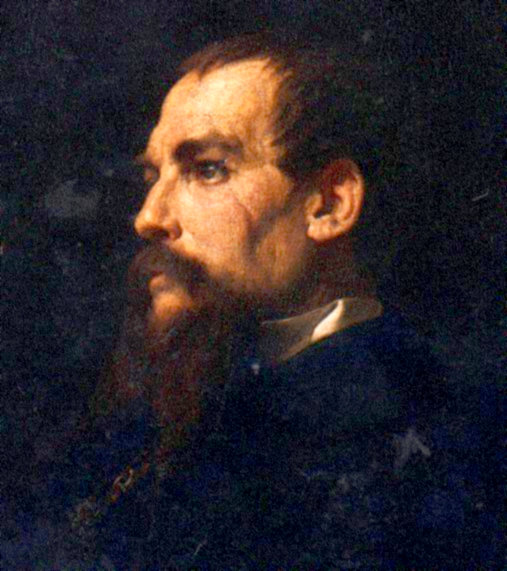
Captain Sir Richard Burton

File:RichardFrancisBurton.jpeg

I once had an alarm clock that I found particularly abrasive.  Whenever it would sound in the morning, a clanging, jangling double-bell that would vibrate the entire mechanism off of the nightstand and send me close to cardiac arrest, I felt as if I had been assaulted somehow.

Now, imagine waking one morning to discover a Somali spear rammed completely through your face from cheek to cheek.  That alarm clock doesn't seem so bad anymore.

Such was a day in the life of Sir Richard Burton, a captain not in the British Army, but of the East India Company [yes, it had its own army], a linguist who had knowledge of an estimated 29 languages, a cartographer who was the first to chart portions of East Africa, a swordsman who wrote the manual on the strategic and tactical use of the blade in combat [a manual still read by officers in the Royal Army], an explorer who was the first European to set eyes upon Lake Tanganyika, and a diplomat with the Foreign Office.

I should mention that he dualed rather a lot while at university; they didn't have "beer pong" in those days.

He was also a spy, a poet, a translator of works such as The Arabian Nights, and, in particular, an accomplished master of disguise.  In other words, he was a typical 19th century adventurer: bold, educated, audacious, curious and, when necessary, mildly homicidal.

Burton was born in 1822 to a military officer father and a mother who was from a family of property.  That meant that, since birth, he would be guaranteed both an education and a position in the army. Since his parents had a love of travel and the wherewithal to indulge it, Burton grew up living throughout Europe, picking up a variety of conversational languages from his various tutors.  Eventually, he was formally schooled in London and at Oxford's Trinity College.  In keeping with the tradition of accomplished Victorians, he was expelled.  The one lasting experience for Burton at college was learning Arabic to fluency.

[Some day I'm going to compile a list of men and women of letters and science who either never participated in higher education or were invited to leave the hallowed halls.]

He then "accepted" a commission in the East India Company's army, hoping to fight in the First Afghan War, but the conflict ended before he arrived in India.  For someone like Burton there could have been nothing more dull than a peacetime military, so he threw himself into the further study of fencing, into investigating Hindu culture, and into a working knowledge of Hindi and Persian.  When offered the chance to lead a survey into an area highly dangerous to European officers, he jumped at the chance.  In order to survive the command, he disguised himself so successfully that neither the locals nor his fellow officers recognized him.

Burton disguised as a camel.  No, no, that's not right.  Burton disguised as an Arab shepherd.
[Readers familiar with Kipling's thrilling yarn Kim will recognize Burton as the inspiration for the character of "Colonel Creighton"; as well as for the protagonist in George MacDonald Fraser's extremely entertaining "Harry Flashman" novels.]

As his interest in Islam and its culture and languages began to increase, along with his facility at successful disguise, Burton decided to undertake one of the most dangerous experiences of his already dangerous existence.  Using his ability in Arabic, his close study of Islamic custom, and his knowledge of the Koran [he had already published his translation of the sacred book], he would disguise himself as a Muslim trader and join in the pilgrimage to Mecca in order to...well, in order to do what no Britisher had done before.  Does there need to be a better reason?
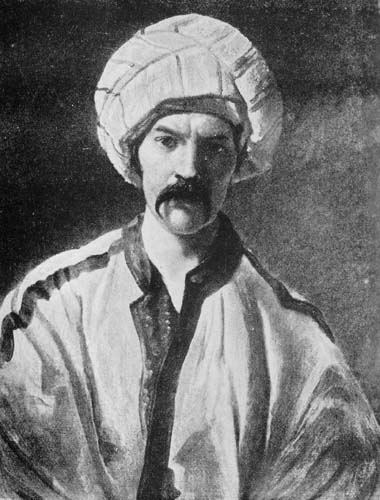

Burton practicing trying to kill people with his mind.

So he did, risking discovery and inevitable death during every hour of the Hajj.  He was successful, though, and marked the occasion by writing a two-volume book, Personal Narrative of a Pilgrimage to Al-Madinah & Meccah.  [Note: the book is now in public domain and may be "purchased" at no cost for those with electronic reading devices.]  The pilgrimage was so transformative that he practiced Islam for the remainder of his life.

And what a life it was.  His adventures in Mecca were merely the beginning, as Burton became one of the eminent explorers of the African continent, determined to discover the source of the Nile River.  To do so, Burton and his colleagues had to travel through remarkably dangerous territory [What else is new?] in the eastern portion for the continent, meeting tribes both friendly and hostile; some of them friendly one day and hostile the next.  Hence the moment described earlier, which necessitated Burton beating a hasty retreat from his attackers with a spear still protruding from both sides of his face.  In later life he would complain that he lost a tooth because of it.

Two years later Burton, with his co-explorer Richard Speake, began a second journey that was beset with so many maladies that it's a wonder both men were not kept in jars for study at a medical school.  Plagued by dysentery, fevers, ear infections leading to partial deafness, blindness, and lame-ness, the two explorers finally arrived at what they named Lake Tanganyika in February of 1858.  Speake, in a subsequent adventure, would come upon Lake Victoria and declare it the Nile's source.

There were other adventures for Burton, not the least of which was having to prove himself not a fraud before the Royal Geographical Society and dealing with a lawsuit filed by Speake, the impetus for which is still a little cloudy.  It would remain so as Speake died from an accidental [?] discharge from a shotgun before things between the two men were resolved.

Burton would live to the age 69, serving during the final third of his life as a British counsel in a variety of posts, from the Congo to Brazil to Damascus, with the final posting in Trieste, Italy.  For those of us raised on British boys' magazines, filled with the lusty adventures of explorers and soldiers, Burton's always set the highest standard.  For all of the derring-do, it should be noted that, before the era of formalized anthropological study, Burton kept very detailed and scientific notes on all of his explorations and discoveries.  Since his range of interests was so broad and deep, these mid-19th century notes were invaluable to the next several generations of cartographers, anthropologists, ethnologists, archaeologists, and diplomats.

Burton is interred in a stone crypt in London that is carved to resemble the tents still used by the hajji during the spiritual pilgrimage to Mecca.  The fact that a practicing Muslim is buried in a Roman Catholic churchyard is the result of some subterfuge by Mrs. Burton; subterfuge being the theme of Burton's life, that seems rather perfect.


Burton's narratives and translations are still in print, with many, as noted above, now in public domain and thus available at no cost.  A rather good biography by Edward Rice entitled simply Captain Sir Richard Francis Burton, which was originally published in the mid-1990's, is still in print and worth reading.  A film entitled Mountains of the Moon, primarily about Burton and Speake's African explorations, was released about 25 years ago and is available on DVD and in digital format.  I seem to recall it earned "two thumbs up" from a corpulent film reviewer and his partner.

Thursday, March 21, 2013

Uh-Huh

Another governor discovers that he doesn't know much about guns and gun parts, but pushes through legislation anyway.

New York Times: New York Governor Favors Easing His Own Newly Passed Gun Law

Wait now, I thought the original law was, in the gov's words, designed to "overpower extremists with intelligence and with reason and with common sense."  Uh, huh.  How rare, a boasting politician.

Unfortunately, Mr. Intelligence-Reason-Common Sense forgot about a few things.  First, all of the weapons used by law enforcement in his state carry more than seven rounds in their magazines [please don't call them "clips"; they aren't clips] and, since there was no law enforcement exemption, every single law enforcement officer in New York was in violation of the new law.

Second, who the heck makes magazines that carry fewer than ten rounds?  [Well, I guess those who own handguns that use the 1911 design; so a whopping 5% of manufactured magazines fit the new law.  Why does an Episcopal priest know more about guns than a fellow who signs bills into law?]

Third, there are a number of gun and part manufacturers in New York.  Imagine if they, like some of those companies in Colorado, simply leave a high-tax, high-regulation state for a friendlier environment, taking hundreds, perhaps thousands of jobs with them?  America has a fluid economy, or so I'm told.

Fourth, legislative overreach disquiets the general population, which may be seen in the governor's dropping approval ratings.  This may be his strongest motivation, especially since he hasn't kept it a secret that he wishes to run for president.  [I hope he modifies his bellowing public speaking style if he does, because he reminds me of some semi-literate footballers in schools in which I've taught when they had to say something at a pep rally.]

Laws will only constrain the law-abiding; by definition, criminals and lunatics exist outside of laws.  If intelligence, reason, and common-sense were actually employed by boastful, bellowing pharisees, they would address the real cause of mass violence: psychotropic medication, which is a common factor in every single mass shooting over the last fifteen years.

You may wonder why this is of any concern to me, and I suppose it's because of a number of things.  Since I was born and raised in an area of the country where gun ownership, the safe handling of guns, and their use in hunting were considered normal, I'm always a little touchy about the easy stereotypes that are painted on Midwesterners [and Westerners and Southerners] by the media and the New York-D.C. political establishment, along with their West Coast equivalents.  The recent article in the Washington Post explaining to its readers that, in some parts of the country, hunting and fishing are normal boyhood experiences reminded me of just how distant the contemporary educated, urban male is from such normal activities. 

We are Cuomo's "extremists", apparently; those whom he dismisses as creatures who need to be controlled by those such as himself who are graced with the reason and the intelligence and the common sense.  All because I own a rifle and know how to operate it, I am somehow to be the government's chattel.

The other is that it now seems clear that the events in Newtown are merely seen as a convenience to those like Cuomo and Bloomberg [who is underwriting much of the current "guns are icky" frenzy as part of his bizarre control need] that could be exploited to further their intentions.  I don't believe they care much about the victims or survivors of that atrocity outside of their usefulness in furthering the power of government officials. 

Historically, power is gained through coercion and the manipulation of fear, and that's the intention behind these actions.  There is nothing that has been suggested in the manner of gun control that would have prevented the events in our state.  The mass killing of children was not caused by a particular type of handle on a rifle [if indeed, a rifle was used; since the report has not yet been released, we don't officially know what really happened] or the number of rounds contained in a magazine [not to brag, but this timid clergyman can change magazines in a rifle so fast that there would be no significant interruption in the rate of fire; it was the government that trained me how to do that, by the way], or how "scary" a rifle looks to a senator from California.

It was caused by people pretending that madness was not in their midst, and who were unfortunate enough to live in a state that, over the last twenty years, has reduced the number of treatment facilities for the mentally ill by 75%.  The fact that politicians continue to draw attention away from what could really make a difference is a social concern that, in a healthy world, or in a greater church with true, thoughtful leadership, would be in desperate need of address.

Related:  The Daily Beast - Did the Assault-Weapons Ban Kill Gun Control?

The United Nations Should Be Involved In This

School Asks Students to Ditch Axe Body Spray

Scotland The Brave; And A Little Weird

The Free Church of Scotland is pushing a bill that will allow people that have made the Star Wars movies their religion the power to perform marriage ceremonies, according to Yahoo! News.
The Marriage and Civil Partnership Bill would apply to both religious and nonreligious groups that include the Flat Earth Society and, yes, the Jedi Knights Society, aka the Temple of the Jedi Order.

Tuesday, March 19, 2013

"Materialism is a premise of science, not a finding."

The "new" new atheists [as opposed to the classical atheists, post-modern atheists, and formerly new atheists] are great believers in Materialism: only things that can be scientifically measured actually exist.  According to them, since God cannot be scientifically perceived or measured, God doesn't exist.  This view elevates science as the ultimate arbiter of what is real and what is not.  Science now replaces metaphysics, in that the study of anything that cannot currently be measured need not be intellectually engaged.

[Only once did I see the late Christopher Hitchens, one of the "new" new atheists, live.  He was onstage during one of those interminable debates about the existence of God; interminable because I can never understand why his opponents always fall for the impossible role of debating a negative statement.  Anyway, he was, in the parlance, blasted out of his mind; drunk as a lord; gooned on liquor.  He was also smoking cigarette after cigarette.  It occurred to me then that, if science, with its ability to accurately measure and note things such as the negative health effects of smoking and excessive drinking, is now the highest appeal in human existence, Hitchens was without question preaching a world view that he did not respect or share.  He was a fake.  Interestingly, he died of esophageal cancer, which is scientifically related to the practice of heavy simultaneous smoking and alcohol consumption.]

There's a new book that explores Materialistic view of human existence and finds it wanting.  From Ferguson's Mind and Cosmos: Why the Materialist Neo-Darwinian Conception of Nature Is Almost Certainly False, comes this gem:
From a fruitful method, materialism becomes an axiom: If science can’t quantify something, it doesn’t exist, and so the subjective, unquantifiable, immaterial “manifest image” of our mental life is proved to be an illusion....
But this is a fatal weakness for a theory that aspires to be a comprehensive picture of the world. With magnetic resonance imaging, science can tell us which parts of my brain light
up when, for example, I glimpse my daughter’s face in a crowd; the bouncing neurons can be observed and measured. Science cannot quantify or describe the feelings I experience when I see my daughter. Yet the feelings are no less real than the neurons.

The point sounds more sentimental than it is. My bouncing neurons and my feelings of love and obligation are unquestionably bound together. But the difference between the neurons and the feelings, the material and the mental, is a qualitative difference, a difference in kind. And of the two, reductive materialism can capture only one.